Friday, August 16, 2013

Just One Letter Project - Week 5
Your Questions Can Be Friends or Foes


So we spent some time last week catching up on the Just One Letter Project.

This week and the coming weeks, we will start pulling together ideas and gaining a better grasp of the intent that Paul had when we wrote to the church he had started in Phillipi, one of the first churches on the European continent.

To get us moving in that direction, we have to first address QUESTIONS.  You have them. You probably been asking questions each week as you have been reading this letter. You may not hear yourself ask them but they are there running around your brain.  You are asking questions all the time.

At First ... Questions Can Be Your Foe Not Your Friend

Probably, those first questions you ask are more like a foe than a friend. Don't get me wrong, the questions are great. You want to have questions. But when you first began reading this letter , the questions often get in the way. They can be your foe because they can distract you and take your brain down rabbit trails that have no end. Or they can discourage you because you don't know the answer immediately ... which set some us down a fatalistic trail of "well I guess the Bible is just too complicated."

Even in the first paragraph or two of this letter, some words or phrases can

  • " Paul and Timothy, slaves of Christ Jesus" (1:1) - What does this mean? Was Jesus a slave owner?
  • "...including the elders and deacons (1:2)? - Who are they? What are they? 
  • "on the day that Christ returns" (1:6)?  So what is taking him so long? So do I have to become a weird prophecy person like those people on TV and endlessly talk about "end times"?
Initially, these kinds of questions can be like ... "white noise" that keep you from seeing and hearing what is more easily understood.

So this week, when you read through letter to the church at Philippi, keep an index card or a post-it note nearby and just jot down those questions that begin to rattle in your brain. 

But then press on ... ignoring them for now. And listen for what is clear initially not what is unclear!

Later ... Questions Are Your Friends not Foes 

Then ...  if we can let the questions sit for a bit and not distract us ... we can start seeing and hearing the bigger themes in a letter like this one. Themes like ...
  • What I learn about God and how he relates to this group.
  • What I learn about the letter writer - and the example of his life. 
  • What issues are being addressed in this community and what is the counsel given. 
  • What instructions or directions are given for understanding God's gospel are offered.
So as you read the letter this week, try to note, highlight or summarize answers to these questions above, instead of being initially distracted by the other questions. And you will leave this reading having a first grasp of some of what was important to Paul when he first wrote.

Then with these BIGGER themes in place, we can come back and evaluate the importance of some of the other questions and then begin investigating answers. Then these questions that were once foes will really become friends.

Friday, August 2, 2013

Just One Letter - Week 3
Following The Road Signs

So ... we are at week three of the Just One Letter Project.  From here on out, you can expect to begin noticing things you have not noticed so far. As you become more familiar with the words in this letter, you will be free to notice the things that are actually being said. You will find yourself asking questions about meaning and purpose. And even having "raised eyebrow" responses of confusion!

This is good. It may be a little frustrating, but hold on, it will get better.  In a week or two, you will start to have some of your own "aha" moments and things will come together.

Trust me. It will be S-A-W-E-E-E-E-T!

As you read Paul's letter to the church in Philippi this week, watch and listen for statements that take the form of a request or a command. Here are a couple of examples.

             "Above all, you must live as citizens of heaven ... " (Philippians 1:27)

             "Don't be intimidated in anyway by your enemies ..." (Philippians 1:28)

There are at least 20 commands in this letter.  This "imperative mood" is one of the common features of Paul's letter. (Now I know I just dropped a English grammar bomb on many of you ... I did it only to see if there were any English teachers out there reading this post!)

The Death Spiral of Wrong Assumptions about the Bible

Now let's pause for a moment and deal with our heart posture. Just writing that sentence, "there are least 20 commands in this letter" generates a reaction within me. A reaction that can quickly spiral out of control.  Here is the death spiral of false assumptions about commands in the Bible:
  • Commands in the Bible have a "yelling voice" attached to them (like my mother or father on their worst days).
  • God is yelling at me
  • Commands in the bible automatically mean prohibitions.
  • Prohibitions rob me of my freedom (like this morning ... I tried to buy beer today at 6:45 am and the law in my state does not let you buy beer until 7:00 am ... It was not a pretty response, just saying!)
  • God is against my freedom. 
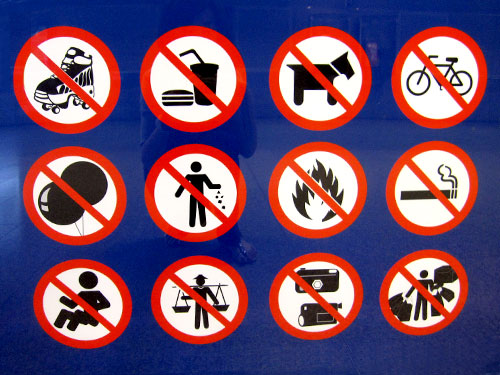
    Rules in Bangkok MRT stations
    Many think the Bible is just a book of prohibitions
  • God is against me!
  • Screw God!
So this death spiral can lead us to a default heart posture that the Bible looks like this sign.

Just look at that sign! Balloons, sitting and eating are prohibited. Wherever this is, I know I don't want to go there! I am guaranteed to be arrested for something.

And this default posture is not at all helped by the experience many have with Christian preachers of various stripes!


Could the Bible Actually Be Offering Direction 
to Experiencing Whole LIFE?

Now prohibition signs, like the ones above, are commands not to do something. But there are other kinds of signs that are commands that tell us to do something. These signs offer direction, understanding of the road ahead and prepare us to navigate different situations. These signs keep us alive. They help us actually be safe while we drive at 70 miles per hour and get us to our destination in one piece. If you are a driver, you see these signs all the time. 


These signs are actually "shouting commands" at us. But somehow our hearts don't hear them yelling, we hear them helping us drive safely, protect our passengers and get us HOME in one piece. 

What is your assumption about the Bible? As you read this week and look for commands, pay attention to your default heart setting towards the commands. Which set of signs reflect how you think the Bible is oriented?

Here is where I land ... the commands in the Bible are more like the road signs offering me direction. Sometimes they include prohibitions ... which in general are there to keep me from driving over a cliff (which I have done with my life a number of times!)

Oh yea ... one last thing ... the apostle Paul is not yelling because God is not yelling. The gospel of Jesus is not about yelling. Just saying ... in case you were wondering.